Company Size and Corporate Strategy
Company size is a strategic decision. This decision, like all corporate strategy decision, is made by examining a company or nonprofit organization’s external environment.
Coase’s theory of the firm tells us that big companies are big because they have decided to take in-house tasks that could otherwise have been performed out in the marketplace. Company decision makers make this decision because they think these tasks can be performed at less cost by their own employees than by external vendors even though adding tasks and employees increases the company’s management load and there are diminishing returns to management.
In order for that strategic decision to make economic sense, the transaction costs in the marketplace must be higher than the extra management costs from adding these tasks and employees. If those transaction costs decrease, meaning that it now becomes less costly to pay for whatever product or service out in the market, then the company is strategically misaligned. The company, structured in this way with higher internal managerial costs than the market will bear, can no longer produce its own product or service at a competitive price. Unless it changes its own management structure, the company will eventually decline.
Business writers use the term downsize to refer to this change in a company’s management structure. Most often so-called “middle management” jobs are eliminated when this occurs. This is painful and costly both for the employees of course but also for the company itself.
That’s why it is in the best interest of a big company for those transaction costs inherent in market transactions to remain high. That enables the company’s expensive management costs to continue being justified.
Transaction Costs and Social Trust
The primary reason for transaction costs to be high is low social trust. Low social trust environments require more lawyers, inspectors, guards, auditors, insurance, and so forth. High social trust environments like Amish communities have very minimal if any need for any of those services and therefore have very low to nonexistent transaction costs. That is also why companies in these high social trust economic environments do not tend to employ many if any managers, security or human relations staff to provide these services internally.
High trust social networks favor many small companies along supply chains. Low trust social networks favor a few big companies along the supply chain, especially at the downstream end. Therefore, a big company is incentivized to do what it can to keep social trust in the marketplace low.
The Managerial Class
More specifically, the managerial employees of big companies and big organizations as well as their colleagues in professional firms are incentivized to maintain low social trust networks. Otherwise, their own jobs would not be needed in that marketplace.
Further, they are also incentivized to demonstrate both the competency of their profession at managing away the problems inherent in operating within low social trust environments and their own individual competency as professionals. Otherwise, even if there exists a need to deal with the problems inherent in a low social trust environment, their profession and their own job would be ineffective and economically useless.
These employees’ professional training inculcates a habit of seeing the world as a set of problems that can and should be managed away or at worst ameliorated. The specific methods for managing the world’s problems vary by profession, of course, but always involve a mixture of codified regulations, procedures and techniques.
Those who would resist such managerial efforts must in their eyes be unqualified to render sound social judgment due to their ignorance of these better more professional ways of managing the world. Further, this social judgment of non-professionals is not merely evidence of two opinions on the same subject but a social threat to their careful management of the world akin to the way that seeing a termite panics a homeowner into action before their house is destroyed.
Thus, the non-world-managers become “a basket of deplorables” or “garbage” in political and cultural discourse. This itself neatly feeds into further deterioration of social trust and grows the need for ever more management.
Rise of the Managerial Class
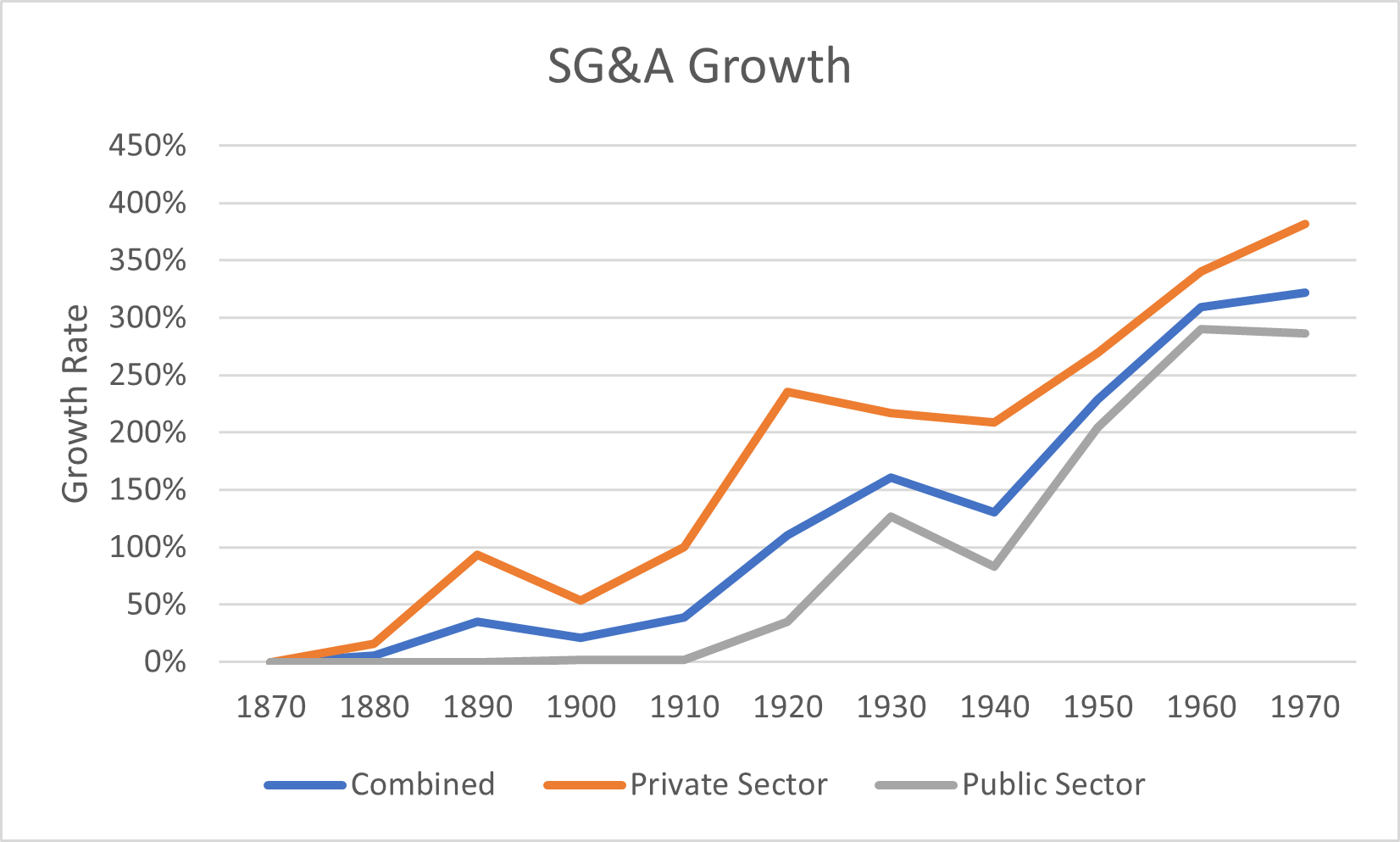
That the rapid rise to prominence of the managerial class occurred alongside all the economic growth, social change, and medical and technological marvels of the past 150 years apparently justifies their hubris. Within the private sector of the American economy, the share of salaries and costs from these workers went from 2% of Gross National Product in 1870 to more than 10% by 1970. The wages and costs of managers, administrators, sales staff, clerks, lawyers, accountants, foremen, inspectors, guards, and human relations staff grew by more than 380% over that hundred year span.
By 1970 transaction costs within the private sector alone amounted to a little more than 40% of America’s Gross National Product. That means that for every dollar of private sector economic activity 40 cents went either to these workers, trade industry (wholesalers, distributors, and retailers) workers, or FIRE industry (finance, insurance, and real estate) workers. This trend has only accelerated since 1970.
Both Primary Producers and End Consumers Pay the Price
At whose expense does this growing share of the American economy come? Their growth comes at the expense of the primary producers at the top of America’s value chains and the end consumers.
To recognize this, consider the difference between buying a jug of apple cider from a local farmer versus a retail store. First, imagine that they are identical products being sold identically in every way including their identical price of $10. When you hand the farmer your $10 bill, the farmer pays for all of her farm expenses used in producing that jug of apple cider and keeps the difference for herself as profit. When instead you scan your credit card at the retailer’s self-checkout kiosk for $10, how much of that $10 makes its way to that farmer whose apples produced your cider? A small fraction of what she would have received if you had paid her directly.
Hopefully, enough of your $10 spend reaches her to at least cover her expenses. Among other issues, the farmer would be under relentless pressure to lower her costs both by all the wholesale buyers trying to minimize their own expenses and also by their requirements that she comply with a myriad of regulations and follow often byzantine vendor processing routines.
At this point mainstream economics would insist that this pressure to lower costs is a net good for society. The farmer, it would be said, would become more efficient through this marketplace participation. Notice, however, that a significant part of the cost reduction pressure she faces is so that she can comply with the transaction requirements of the bigger companies. Big downstream companies can and do force their upstream providers to comply with all sorts of expensive–in terms of time, cost or both–requirements that have nothing whatsoever to do with producing apple cider. Instead they have everything to do with selling to the big downstream company. Mainstream economics assumes that all transactions are frictionless even though that is obviously unrealistic.
There is no social benefit to these transaction costs that the upstream provider pays. The benefit flows entirely to the aforementioned professionals, managerial employees and those who own the big companies employing them. None of that benefit flows into the apple cider product for the end consumer.
Now imagine that we make this scenario more realistic by allowing for the prices of the apple cider jugs to be different. The farmer is still selling her jug of apple cider for $10 at her roadside stand. Now consider two alternative scenarios.
In the less common scenario, the apple cider is being sold at a retailer like Whole Foods purporting to do good by the farmer while also providing the consumer with the confidence of product quality and the convenience of not having to drive to the farm. In order for this sales claim to be true, this retailer must charge the consumer more than $10 for the apple cider. To not squeeze the farmer, the farmer is still paid $10. Additionally, all the costs of transacting, storing, displaying, selling and managing all those tasks to bring the apple cider to the consumer must also be covered. These are the transaction costs that the retailer has internalized. Notice that transportation costs are excluded because the consumer and the retailer both incur this cost. Unless the retailer has substantial cost efficiencies, the markup on the apple cider will be significant and almost always more than the consumer would be willing to pay.
As a result, the much more common scenario is that the farmer is paid less for her apple cider and the end consumer is provided with an inferior product in exchange for the retailer’s provision of convenience and assurance. And this is what usually happens. The consumer receives something called apple cider from the store that in terms of quality is so far removed from the farm stand apple cider as to be a different product type altogether.
Consider how quality has declined over the years. Whether in foods like apple cider or durable goods like washing machines, consumers have been receiving increasingly inferior products compared to what their parents, grandparents and great grandparents would have received. Big companies try to mask this quality difference by bolting on techno-enhancements and through slick advertising.
Both upstream producers and end consumers pay for the growing role that transaction costs play in the American economy. Low trust social networks support this economic regime. Big companies benefit from operating in this type of economic environment.






0 Comments
No comments yet. Be the first to comment